
3 Ways Stress Makes Pain Worse — and How PT Breaks the Cycle
Why Stress Makes Pain Worse — And What Physical Therapy Does About It
Your back goes out every time a deadline hits. Your neck tightens up when work gets heavy. You've been dealing with shoulder pain for four months and nothing explains it — no injury, no specific incident, clean imaging.
Stress is doing something real to your body. Not metaphorically. Physiologically. And once you understand the mechanism, a lot of things that haven't made sense start to.
This guide covers what stress actually does to your nervous system and muscles, why it creates pain that doesn't respond to standard fixes, and how physical therapy addresses the underlying driver — not just the tissue reporting the symptoms.
Does Stress Actually Cause Physical Pain?
Yes — and it does it through measurable biological pathways, not psychology.
When stress is chronic, your body stays in a low-grade threat state. Your nervous system is designed to respond to danger by preparing muscles to move, flooding your bloodstream with cortisol, and heightening sensitivity to incoming signals. All useful in short bursts. When that state becomes your baseline, it starts producing pain directly.
The clinical term for what happens to your nervous system under sustained stress is central sensitization — a state where pain-processing pathways become overactive and begin amplifying inputs that would normally be filtered out. You feel more pain from the same stimulus. Pain that should resolve on its own doesn't. Areas that weren't originally affected start hurting.
This is not weakness. It's a nervous system that has been calibrated toward threat for too long.
Why Stress Makes Existing Pain Worse
Your muscles never fully let go
The sympathetic nervous system — the fight-or-flight branch — keeps muscles in a low-grade state of readiness when stress runs high. Your upper traps, jaw, and lumbar extensors are the most susceptible. They hold a low-level contraction even at rest, not because you've been using them hard, but because your nervous system keeps them primed.
This is why stressed patients present with elevated resting muscle tone in areas they haven't been loading. They stretch, get temporary relief, and tighten back up within hours. Stretching doesn't resolve the neurological signal driving the guarding. That signal has to be addressed directly.
Sleep breaks down — and that matters more than most people know
Chronic stress fragments sleep, particularly the deep sleep stages where tissue repair actually happens. Research published in Frontiers in Neuroscience found that even a single night of disrupted sleep lowers pain thresholds the following day. For patients dealing with both chronic stress and chronic pain, the loop runs in both directions: stress disrupts sleep, poor sleep increases pain sensitivity, pain increases stress. Breaking in anywhere helps.
Cortisol dysregulation changes how your nervous system processes pain
A systematic review in The Journal of Pain found that high perceived stress was independently associated with the development of new-onset chronic musculoskeletal pain — separate from any physical injury. The HPA axis under chronic stress keeps cortisol elevated in ways that alter pain-processing at the spinal cord level. You're not imagining a lower tolerance for pain. Your system has been chemically recalibrated toward greater sensitivity.
Who Gets Stress-Related Pain
There's no single profile, but some patterns show up consistently in clinic.
People in high-demand jobs who've been pushing through physical symptoms for months. Runners and athletes whose recovery stopped working and who can't identify a training error. Active adults whose pain flares during heavy workload periods and settles when things calm down — and who've noticed that pattern but never had anyone explain why it's happening.
What they have in common: they've been treating the tissue while the nervous system driver goes unaddressed. They've rested, stretched, maybe done a round of PT that helped temporarily. Nobody has connected the dots.
What You Can Do at Home
These aren't wellness suggestions. They're direct physiological inputs that target the mechanisms above.
Diaphragmatic breathing, practiced intentionally. Slow nasal breathing with a longer exhale than inhale activates the vagus nerve and shifts the nervous system toward parasympathetic tone. Five to ten minutes daily — a 4-count inhale, 6-count exhale — creates measurable reductions in sympathetic activation. It's not relaxation theater. It's a real input into a dysregulated system.
Consistent movement, not intense training. The evidence on exercise as a pain modulator is strong and consistent: regular moderate movement reduces cortisol, releases endogenous opioids, and downregulates central sensitization over time. Twenty to thirty minutes of walking most days does more for chronic stress-related pain than a hard workout once a week. Intensity is less important than consistency.
Sleep as a clinical priority. A consistent sleep window, a cool room, no screens for an hour before bed. Patients who actually implement this in the context of pain recovery routinely outperform their physical treatment predictions. It's not a lifestyle recommendation — it's a direct intervention on the pain loop.
When to See a PT
Self-management has a ceiling. These are signs you've hit it:
Pain that's been present for more than six weeks with no clear injury behind it
Flare-ups that reliably track with high-stress periods and settle when things calm down
Muscles that feel persistently tight or guarded despite consistent stretching
Sleep that's been disrupted for more than a few weeks alongside physical symptoms
Pain spreading to areas that weren't originally involved
None of these need imaging to explain. They do need a proper clinical assessment — someone who looks at the full picture rather than the structure that showed up on a scan.
Oregon is a direct access state. You don't need a referral to book.
How Physical Therapy Treats Stress-Related Pain
This is where the approach at Timber and Iron looks different from standard rehab.
For most musculoskeletal conditions, treatment targets the tissue. For stress-related and centrally-sensitized pain, the target is the nervous system state driving the symptoms. Those require different approaches.
Pain neuroscience education comes first. The research on this is consistent: patients who understand why their nervous system is behaving the way it is stop catastrophizing, and that cognitive shift produces measurable reductions in pain intensity on its own. This isn't a soft intervention. It's clinical.
Graded loading rebuilds the relationship between your body and movement. For patients whose nervous systems have been in threat mode, movement itself has become associated with danger. The goal isn't just building strength — it's recalibrating what the nervous system reads as safe. Sessions are structured to challenge without triggering a flare, progressively expanding tolerance.
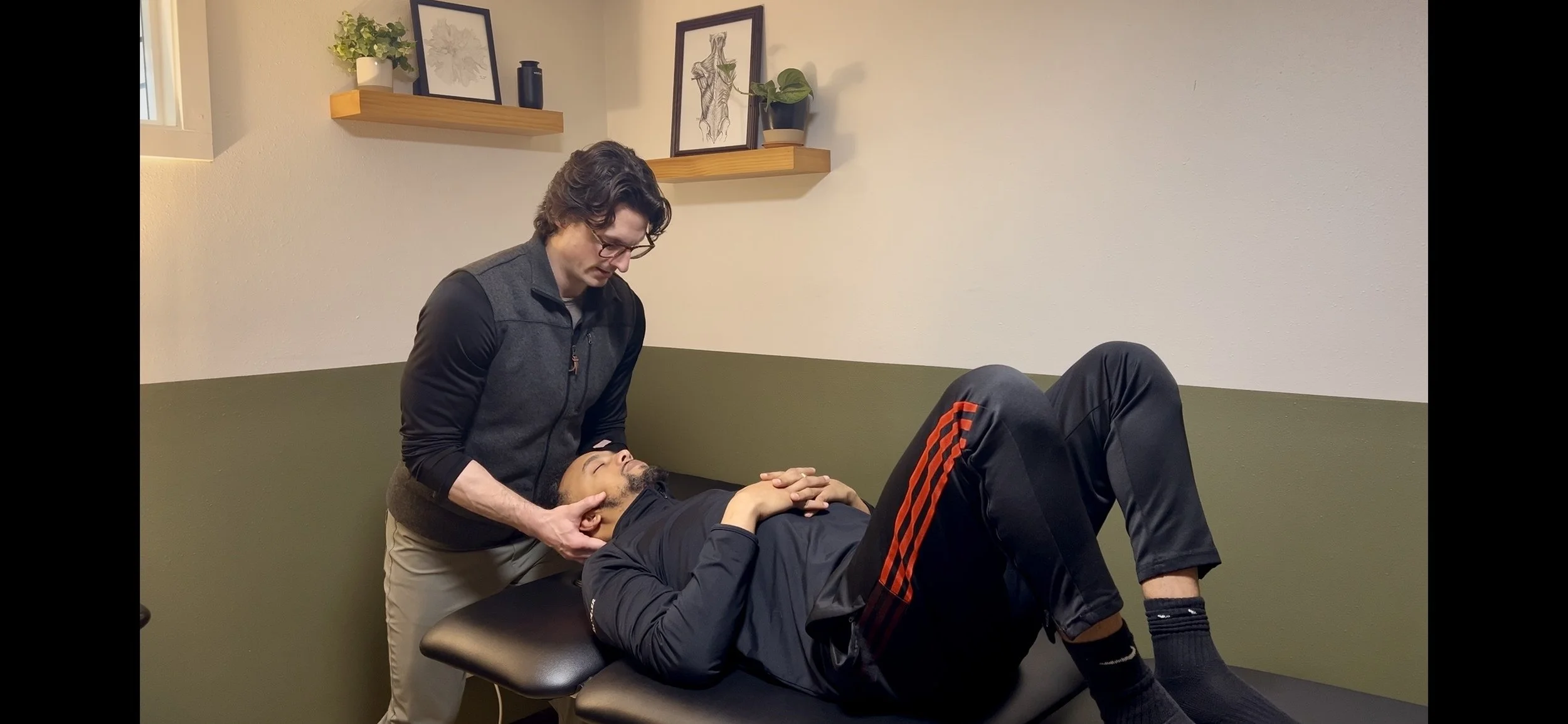
Manual therapy addresses the elevated resting tone in chronically guarded muscles — not to work out a knot, but to provide sensory input that helps the nervous system downregulate. Myofascial Decompression and IASTM are both useful here, depending on what the assessment shows.
At Timber and Iron, Dr. Ryan Eckert, PT, DPT works one-on-one for a full hour — which matters for this patient population more than almost any other. Stress-related pain requires a complete picture of what's driving it. That takes time and undivided attention. A fifteen-minute appointment isn't going to get there.
FAQ
Can stress cause pain in specific body parts, or just general discomfort?
Specific areas. The upper traps, jaw, lumbar extensors, and neck are the most common because these muscle groups are most responsive to sustained sympathetic activation. Patients with high-stress presentations almost always show elevated resting tone in one or more of these regions. The pain location is real — the cause is upstream.
Why does my back always flare up when work gets stressful, even when I'm not lifting or sitting differently?
Because your lumbar extensors are maintaining a low-grade contraction driven by sympathetic tone, not by mechanical load. When that baseline tone is already elevated, any additional demand — even sitting at a desk — pushes over a threshold that your body would normally handle without issue. The flare is a nervous system event, not a structural one.
Will I just need to manage stress better, or is there something PT can actually fix?
Both. Understanding and managing stress matters, and a PT isn't a therapist — Ryan isn't treating the psychological side directly. What PT can do is address the physical consequences: the muscle guarding, the sensitized movement patterns, the deconditioning that accumulates when pain limits activity. Treating the physical manifestations reduces the overall load on the system, which makes the stress itself easier to manage. They feed each other in both directions.
How is this different from what a chiropractor or massage therapist does?
Manual therapy is a component of PT, not the whole thing. For centrally-sensitized pain, the most important interventions are graded exercise, pain education, and nervous system regulation — not manipulation or soft tissue work can help but not alone. Those can provide temporary relief. The goal at Timber and Iron is durable change.
If this sounds like your situation — pain that doesn't match the imaging, flare-ups that track with your stress load, treatments that help briefly but don't stick — a one-hour evaluation at Timber and Iron will tell you more than another round of Googling. We're in Happy Valley and we're easy to reach. Book online or call/text 503-567-4035. No referral required.
This content is for educational purposes only and doesn't constitute medical advice. For guidance specific to your situation, schedule a consultation with Dr. Ryan Eckert at Timber and Iron Physical Therapy.
Timber and Iron Physical Therapy | 10729 SE 82nd Ave, Happy Valley, OR 97086 | 503-567-4035 | timberandironpt.com