
Neck Pain at Your Desk? The Truth About Posture That Most People Get Wrong
Your mom told you to sit up straight. Your HR department sent an ergonomics email. Every productivity influencer on YouTube has an opinion about monitor height. And somehow your neck still hurts.
Here’s what most of that advice misses: the research on posture doesn’t say what most people think it says. There is no single correct sitting position. The 90-degree upright posture that everyone pictures isn’t actually better for your spine than sitting at a slight recline. The problem most desk workers have isn’t that they’re sitting wrong. It’s that they’re sitting still.
At Timber and Iron Physical Therapy in Happy Valley, desk-related neck pain is one of the most common things we evaluate — and one of the most misunderstood. People come in after years of trying to fix their posture and not getting anywhere. It’s rarely because they weren’t trying hard enough. This is the posture conversation that actually moves the needle, and it’s a different one than most people have heard.
What “bad posture” actually does to your neck
The head weighs about 10 to 12 pounds at neutral. That’s manageable. As your head drifts forward — which happens when you’re looking at a monitor, checking your phone, or reading — the effective load on your neck muscles increases fast. At 45 degrees of forward tilt, research estimates that load climbs to around 49 pounds. At 60 degrees, closer to 60.
That’s not a structural problem. That’s physics. Your neck muscles are working harder, for longer, with less rest. That’s where the soreness, stiffness, and headaches come from in most desk workers.
Neck pain from desk work is primarily a load and duration problem, not a positioning problem. Forward head posture increases mechanical demand on cervical muscles, but the bigger driver is how long you hold any position without changing it.
The common prescription — “sit up straight” — addresses about 20% of the issue. Correcting your head position does reduce that load. But if you’re in a perfectly upright posture for four hours without moving, you’re still going to feel it by 3pm.
A 2006 study published in Spine found that a 135-degree reclined posture produced the least spinal disc stress of all sitting positions tested. The upright 90-degree position wasn’t the winner. That finding doesn’t mean you should lounge in your chair all day. It means there isn’t one magic angle you need to hit, and your body handles load better when that load changes.
Why sitting still is the real problem — and why desk neck pain is so common
Your spine is built for movement. The discs between your vertebrae don’t have a direct blood supply — they get their nutrients through compression and decompression as you move. Long stretches of static posture, whether perfectly upright or slouched, reduce that exchange.
The bigger issue for desk workers is what happens to the muscles. When you hold a position for a long stretch, the same motor units fire continuously without rotation. Those fibers fatigue. The low-grade, constant effort of holding your head in a fixed position for hours is surprisingly demanding, and it’s cumulative. Most people don’t notice it building until something tips them over: a stressful week, a longer-than-usual day at the computer, a new home office setup with the monitor at the wrong height.
This is why neck pain from desk work tends to come on gradually and feel hard to pin down. There’s rarely a single moment it started. It builds over weeks or months of sustained, low-variety loading on the same structures.
Remote work shifted a lot of people to home setups with kitchen chairs, laptops on coffee tables, and monitors positioned for convenience rather than ergonomics. Happy Valley, like most of the Portland metro, saw a jump in desk-related complaints after 2020. Most of those patients described the same thing: “I didn’t change anything. I just started hurting.” The setup changed. The commute walk disappeared. Movement variety dropped. The body kept score.
What you can do at home: the posture fix that actually works
Skip the perfect position. Focus on changing positions more often.
A 2020 study in Applied Ergonomics found that microbreaks of one to two minutes every 30 minutes reduced neck and shoulder discomfort in computer workers by up to 54%. You don’t need a standing desk or a new chair to see meaningful results. You need to move more often.
Move every 30 minutes
Set a timer. Stand up, walk to the kitchen, do five neck rolls. It doesn’t need to be a workout. Breaking up the sustained load is the goal. Two minutes of movement every half-hour outperforms an hour at the gym if you’re still stationary for the other seven hours of your day.
Work on chin tucks
Sit or stand tall, then gently retract your chin straight back — not down, not up, just back. Hold two seconds. Repeat ten times. You’re reloading the deep neck flexors that get underused when your head drifts forward. Do this three or four times throughout your workday.
Fix your monitor height
Your gaze should land on the top third of your screen. If the monitor is below eye level, your head will follow it forward. This is the single most common ergonomic setup issue, and it costs nothing to fix.
For more on the shoulder and neck structures involved in desk-related pain, our shoulder pain treatment page covers how we approach them at Timber and Iron.
When to see a PT for desk-related neck pain
Not every tight neck needs a clinical visit. If you’ve started moving more, fixed your monitor height, and things are improving over two to three weeks, keep going.
Come in if:
Pain is radiating into your arm, hand, or shoulder blade, with numbness or tingling
You wake up with neck pain that doesn’t ease as the day progresses
Headaches are frequent and seem to start at the base of your skull
You’ve had this for more than a month and home fixes aren’t moving the needle
You’re starting to limit movement — turning your head less, avoiding certain positions
Radiating symptoms into the arm can indicate nerve involvement, and that warrants proper evaluation. Oregon is a direct access state, which means you don’t need a referral to come see us. If you’re unsure whether what you’re dealing with is typical desk tension or something that needs a closer look, a one-hour eval is a faster and more useful answer than another week of hoping it resolves.
How PT treats desk neck pain — and why physical therapy for neck pain isn’t just massage and stretching
When a patient comes in for neck pain at Timber and Iron Physical Therapy, Dr. Ryan Eckert, PT, DPT works one on one with them for a full hour to figure out what’s actually driving the problem. That almost always involves more than just the neck itself.
Effective physical therapy for neck pain from desk work addresses the whole load pathway, not just where it hurts.
The neck sits at the top of a chain. If your thoracic spine is stiff, your neck compensates. If your shoulders are weak or poorly positioned, your neck takes over. A solid assessment looks at all of it. In practice, treatment typically includes:
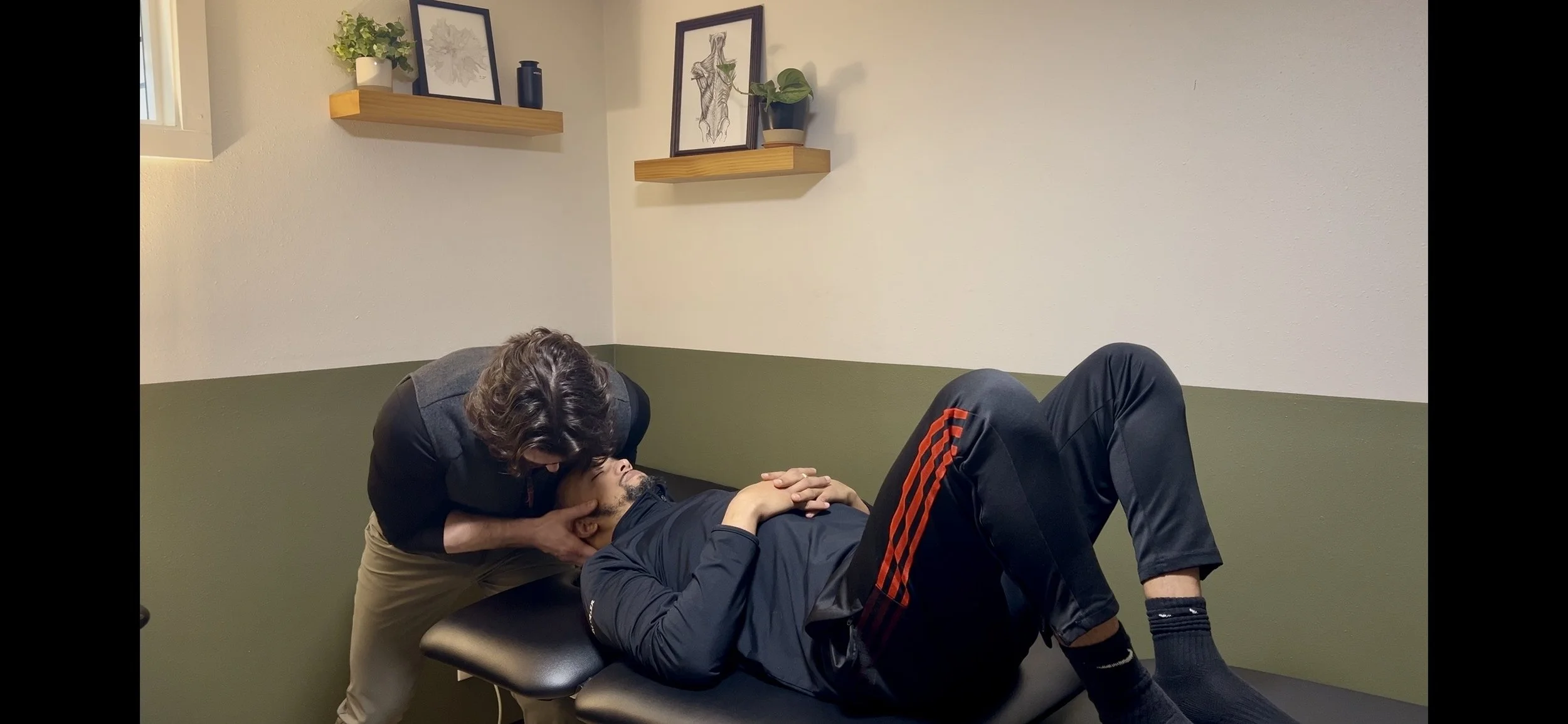
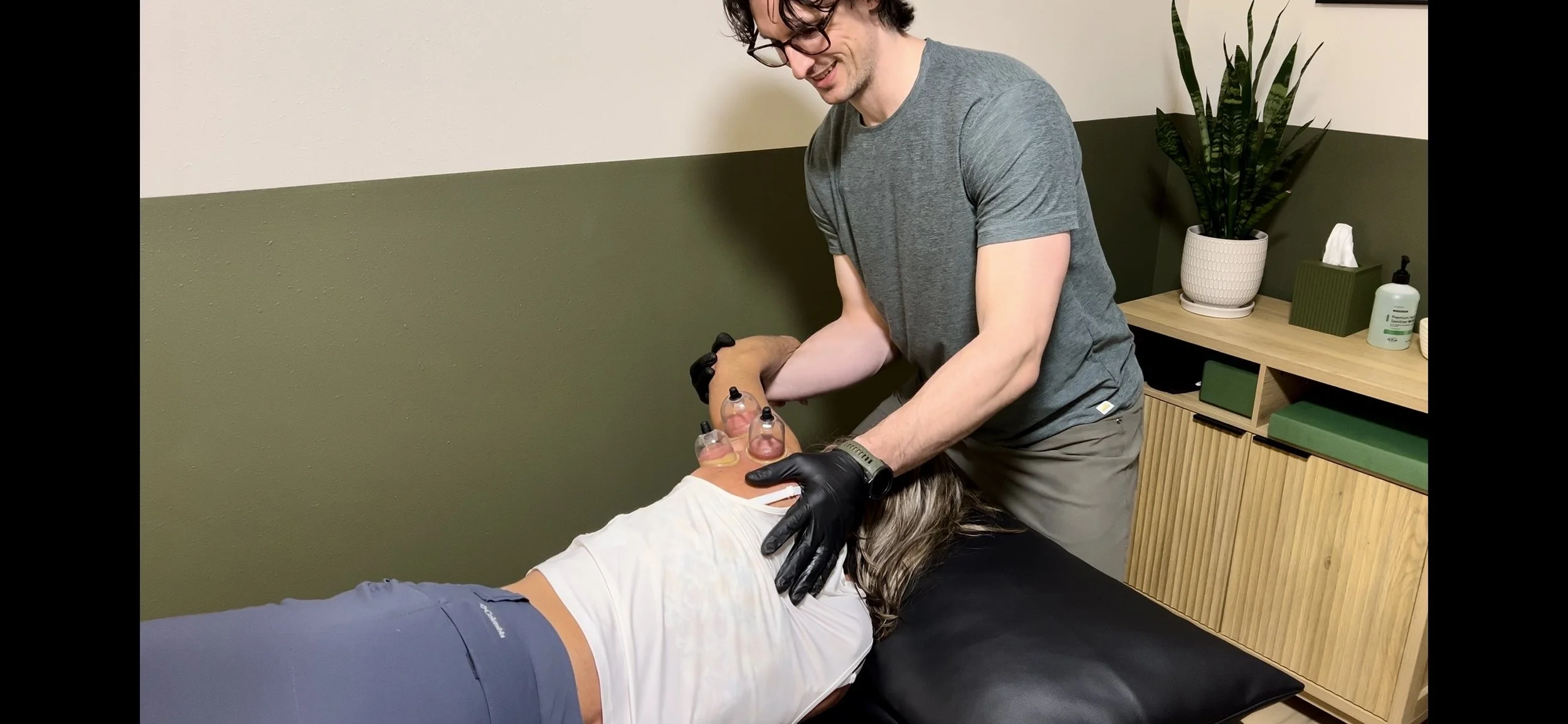
Manual therapy to restore mobility in the cervical and thoracic spine — not just the area that hurts, but the areas that aren’t moving well and forcing other structures to work harder.
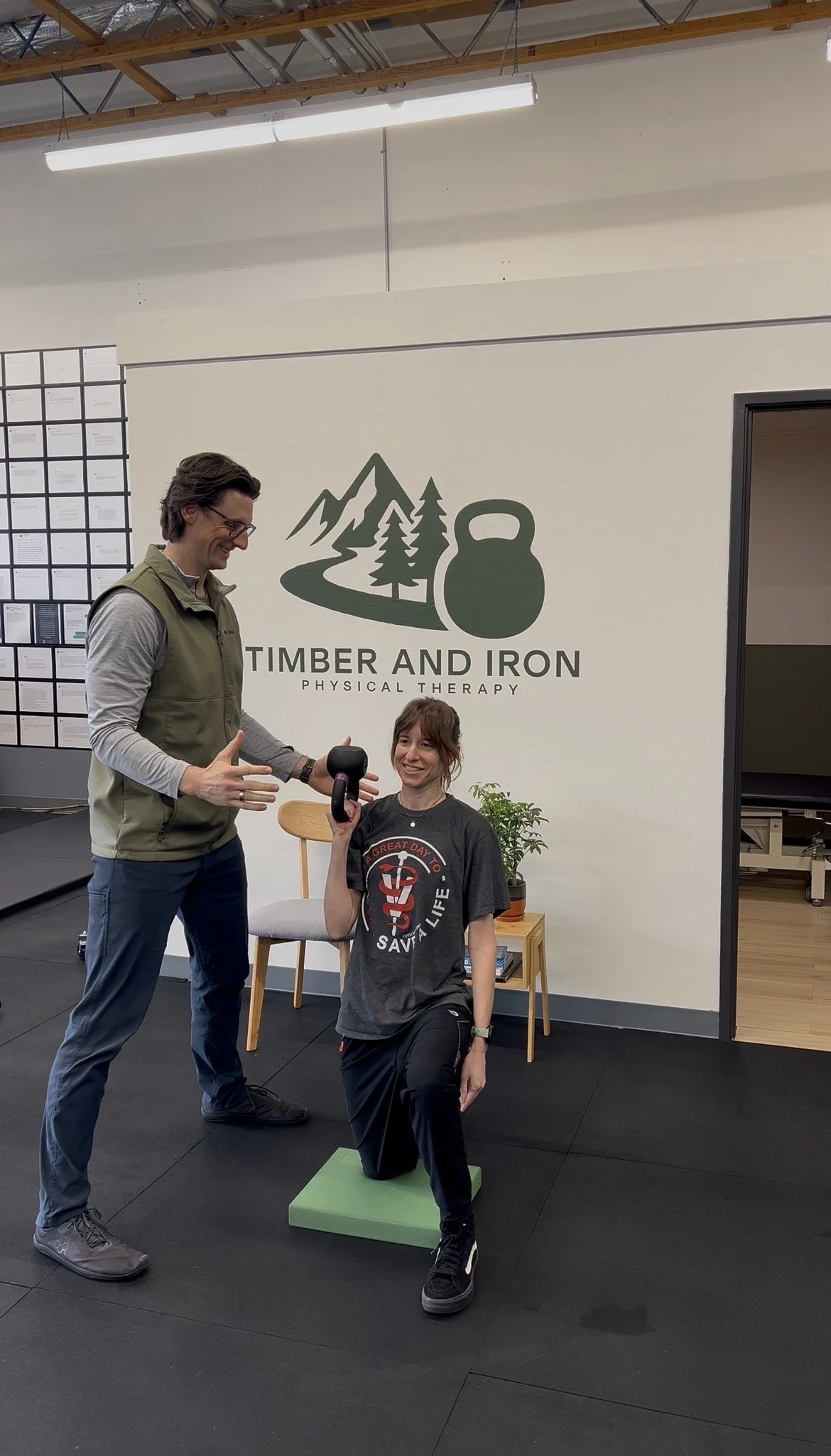
Targeted exercise to strengthen the deep neck flexors, mid-back stabilizers, and shoulder girdle. These are the muscles that hold your head up efficiently. Most people with desk neck pain have underloaded them for years.
Movement education: not as a rule to memorize, but as context for understanding why variety matters and how to build it into a real workday.
We see patients from across Happy Valley and Clackamas County, and the desk worker presentation is one of the most responsive to the right approach. Most people see meaningful change within four to six sessions. For more on what a first visit looks like, our neck pain treatment page has the details.
FAQ: desk posture and neck pain
Is sitting up straight all day actually good for my spine?
Holding any position for extended periods — including a “correct” upright posture — puts sustained demand on the same structures. The research doesn’t identify one ideal posture. Variety is more protective than perfection. Change positions regularly and give your spine time in multiple configurations throughout the day.
How long does it take for desk-related neck pain to go away?
It depends on how long it’s been building and what you do about it. For recent-onset pain with no nerve involvement, consistent movement habits and a few targeted exercises often produce noticeable improvement within two to three weeks. Longer-standing pain typically responds well to PT but needs more time — six to eight weeks is a reasonable expectation for meaningful, lasting change.
Does a standing desk fix neck pain?
Standing desks help if they get you out of sustained sitting, but standing in one spot for four hours has its own load issues. The benefit is the position change, not the standing. A sit-stand desk used actively — alternating through the day — is useful. One set to standing height that you forget to lower isn’t going to solve anything.
Can forward head posture be corrected?
Yes, and it doesn’t require years of work. The forward load mechanics were quantified by Hansraj (2014) — strengthening the deep neck flexors, improving thoracic mobility, and changing the conditions that reinforce the forward position (monitor height, phone habits, pillow setup) all contribute to reversing it. Most people see meaningful improvement within a few weeks of consistent targeted work.
Why does my neck hurt more at the end of the day than in the morning?
The load is cumulative. Your neck muscles handle sustained effort throughout the day and fatigue. The 3pm headache or tension that builds by late afternoon is almost always the result of hours of low-grade, continuous demand without adequate breaks. It’s not that something suddenly went wrong. Your margins ran out.
If any of this sounds familiar, that’s a good reason to come in. A one-hour eval at Timber and Iron will tell you more than another Google search will.
This content is for educational purposes only and doesn’t constitute medical advice. For guidance specific to your situation, schedule a consultation with Dr. Ryan Eckert at Timber and Iron Physical Therapy.