
The 3 Flexibility Areas Every OrangeTheory Athlete Actually Needs (And Why They Matter)
OrangeTheory is a well-designed workout. The treadmill, rower, and floor block each demand real range of motion from specific joints. When that range isn't available, your body doesn't stop moving. It just finds the range somewhere else.
That somewhere else is usually a joint or tissue that wasn't supposed to take that load.
This is the conversation I have regularly with OTF and HIIT athletes who come into the clinic with hip pain, low back tightness after rowing, or knee issues that flare up during squats and lunges. The problem often isn't how hard they're training. It's that their body is missing the flexibility to execute those movements cleanly, so it compensates. Compensation under load, repeated hundreds of times per week, eventually becomes pain.
Here are the three flexibility areas that matter most for OrangeTheory athletes, why each one matters for the specific demands of the workout, and how to address them.
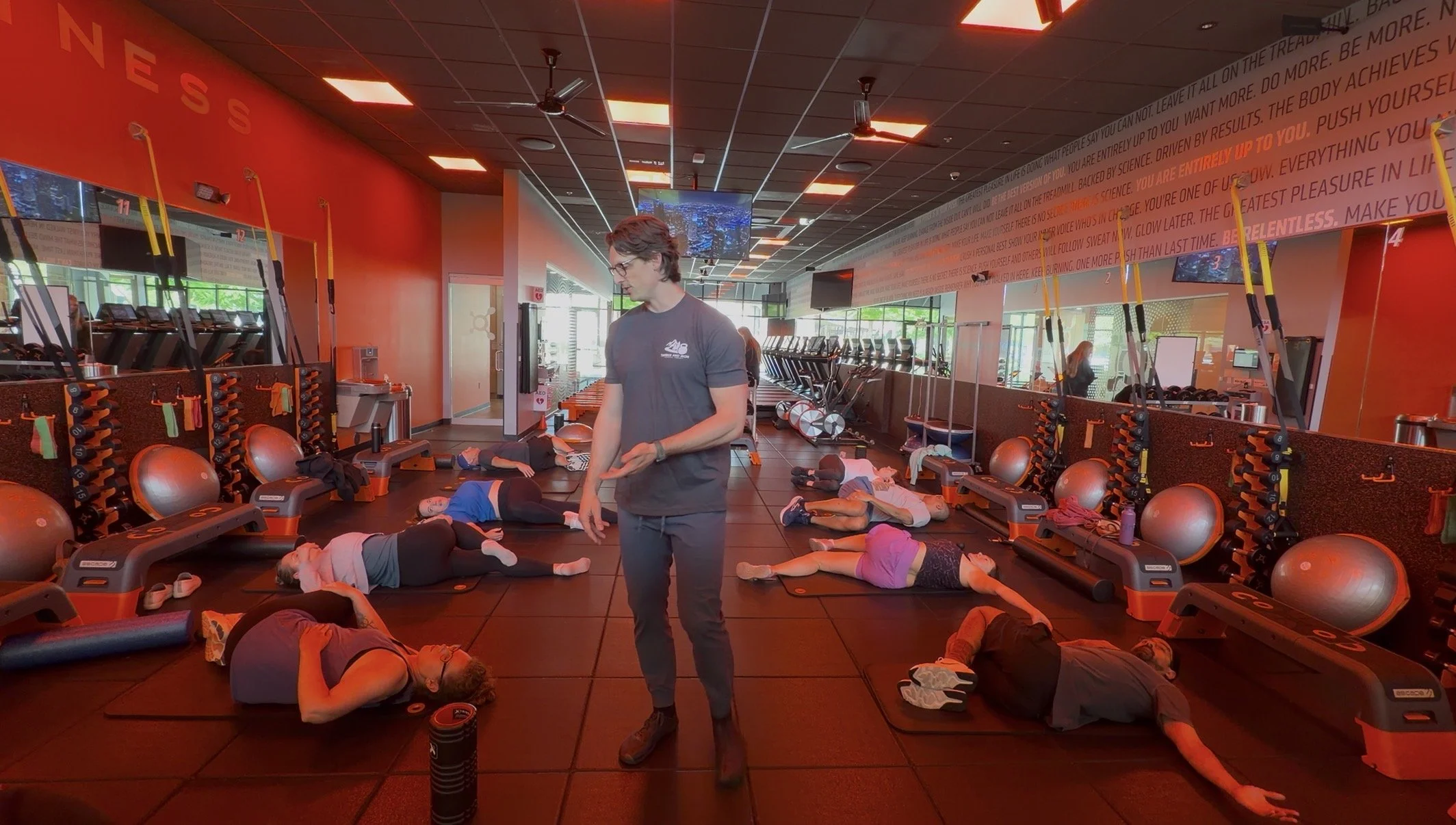
Why Flexibility Matters Before You Load, Not Just After
Most people think of stretching as something you do to recover. Sore hips after class? Stretch them out. Tight calves after a long treadmill block? Calf stretch in the parking lot.
That's not wrong, but it's only half the picture.
Flexibility also determines how cleanly your body can execute a movement before and during loading. When a joint doesn't have the range of motion a movement requires, your nervous system makes a decision in real time: compensate or stop. In a class environment, where the pace is set and stopping isn't easy, compensation wins almost every time.
The three areas below are where that tradeoff shows up most consistently in OTF-style workouts.
Stretch #1: Hip Flexor and Quad Flexibility (Your Treadmill Block Depends on This)
The treadmill block, whether you're running, power walking at incline, or pushing your base pace, requires your hip to reach full extension behind you with every stride. That extension is what drives propulsion. It's also what most people don't have.
When hip flexor and quad flexibility is limited, full hip extension isn't available. So instead of extending through the hip, the body tilts the pelvis forward and extends through the lumbar spine. The stride gets shorter. The low back takes load it wasn't designed for at high repetition.
A 2021 systematic review and meta-analysis in the International Journal of Environmental Research and Public Health confirmed that hip flexor stretching significantly improves hip extension range of motion, and that tight hip flexors are associated with reduced isometric trunk strength. That means the problem affects both movement quality and power output.
The couch stretch (or half-kneeling stretch against a wall) is the most effective tool for this because it targets the rectus femoris, the muscle that crosses both the hip and the knee. A standard lunge stretch does not fully address it.
How to do it (Couch Stretch):
1. Kneel with one shin flat against a wall behind you (or up on a couch or bench).
2. Step the opposite foot forward into a lunge, front knee over ankle.
3. Squeeze the glute on the kneeling side. This is the step most people skip. It's the step that actually creates the stretch by rotating the pelvis posteriorly.
4. Hold 90 seconds per side. Breathe. Don't force the range.
Do this before your treadmill block if time allows, or as part of a daily routine on training days.
Stretch #2: Hamstring Flexibility (For the Rower and Every Hip Hinge)
The rowing stroke has two positions worth understanding. The catch is when your shins are vertical and you're compressed forward at the start of each pull. The finish is when your legs are extended and the handle is drawn to your lower chest. That's the point where the drive is complete and your body is upright.
Hamstring flexibility determines whether you can reach that finish position with a neutral spine or whether your lumbar spine rounds to compensate.
When hamstrings are short, the pelvis can't rotate forward freely during hip extension. At the finish of a rowing stroke, or at the bottom of a deadlift or Romanian deadlift in the floor block, the lumbar spine rounds to make up the difference. That rounding under a loaded or braced spine, done hundreds of times per workout, is a primary driver of the low back pain I see in rowers and lifters.
The fix is hamstring flexibility that allows the pelvis to tilt anteriorly and the spine to stay neutral through the full range of the movement, not just at mid-range where most people are already comfortable.
How to do it (doorway hamstring stretch):
1. Lie on your back in a doorway. Slide your bottom into the opening so you can rest one leg flat on the floor through the doorway.
2. Lift the other leg and rest it against the door frame, as straight as you can comfortably get it.
3. Your back stays flat on the floor throughout. This is the key difference from most hamstring stretches. The floor and door frame enforce the neutral spine position for you.
4. Flex your foot (pull toes toward you) to increase the stretch.
5. Scoot closer to the door frame to increase intensity, or move back to reduce it.
6. Hold 60–90 seconds per side.
The reason this works better than a standing or seated forward fold is that you can't cheat the spine position. Most people round their lower back immediately in a forward fold, which releases tension in the hamstring and misses the point entirely. The doorway removes that option.
Stretch #3: Calf and Ankle Flexibility (For Squats, Inclines, and the Rowing Catch)
Ankle dorsiflexion is the ability of your ankle to bend so your shin moves forward over your foot. It is one of the most underappreciated variables in lower body movement quality. Limited dorsiflexion affects three specific OTF demands:
Squats and lunges: When the ankle can't dorsiflex enough, the heel comes up or the trunk tips forward to compensate. That forward trunk lean shifts load to the low back and changes the mechanics of every squat, lunge, and box jump in the floor block.
Treadmill inclines: Incline walking and running require more ankle dorsiflexion than flat ground. A restricted ankle on incline causes the heel to rise early, which shortens the stride and transfers load up the chain to the knee and hip.
Rowing catch: The catch position requires the shins to be vertical and the body to be compressed forward. Limited ankle dorsiflexion makes a clean catch position difficult to achieve, which typically results in the athlete either sitting too far back on the seat or compensating through the lumbar spine.
There are two calf muscles involved, and they need different stretches. A step gives you more range than a flat-floor or wall stretch because your heel can drop below the level of your foot, which increases the stretch significantly.
How to do it (Step ankle Stretch):
Straight-leg version (gastrocnemius, the larger calf muscle):
1. Stand on a step or stair with the ball of one foot on the edge, heel hanging off.
2. Hold the railing for balance. Lower your heel toward the floor slowly until you feel a stretch in the calf belly.
3. Keep the knee straight throughout.
4. Hold 45–60 seconds per side.
Bent-knee version (soleus, the deeper muscle and the one most people miss):
1. Same position on the step, heel hanging off.
2. Bend the knee slightly, about 20–30 degrees.
3. Lower the heel again. The stretch shifts lower, closer to the Achilles tendon and ankle joint.
4. Hold 45–60 seconds per side.
Both are needed. The soleus is the primary driver of ankle dorsiflexion, and a straight-knee stretch doesn't reach it. If you've been dealing with stiffness at the ankle or difficulty getting into a deep squat position, the bent-knee version is where to start. Most people have never done it and feel an immediate difference.
When Stretching Isn't Enough
Improving these three flexibility areas will make a real difference in how your body handles OTF workouts. You get cleaner mechanics, less compensation, and less wear on joints that were picking up the slack.
But if you've already been dealing with recurring pain: low back tightness after rowing, knee issues during squats, or hip pain that doesn't respond to stretching. There's usually a compensation pattern that's already established. Stretching can improve the range, but it doesn't always reset the movement pattern that formed around the restriction.
That's where a PT assessment is useful. At Timber and Iron PT in Happy Valley, I work regularly with OTF and HIIT athletes in the Clackamas area. A movement assessment can identify where the flexibility deficits are, whether they've created downstream compensation patterns, and what it takes to address both, not just one.
Oregon is a direct access state. You don't need a referral to book.
Schedule at timberandironpt.com or call/text 503-567-4035.
FAQ
Q: Should I do these stretches before or after OrangeTheory?
A: It depends on the stretch. Hip flexor and calf stretches done before class can help improve the range of motion available during the workout, particularly if you're going into a treadmill incline or heavy floor block. Hamstring stretches are generally better done after class or at least 30 minutes post-workout, when the nervous system has calmed down and the tissue is more receptive to lengthening.
Q: How long should I hold each stretch?
A: For meaningful change in tissue length, 60–90 seconds per side is the evidence-backed target for static stretches. Brief 20-second holds are better than nothing, but they don't produce lasting flexibility changes. If you're stretching daily, the 60–90 second holds will compound over 2–3 weeks.
Q: My low back hurts after rowing. Could this be a flexibility problem?
A: Quite possibly. Limited hamstring flexibility is one of the most common contributors to lumbar rounding at the finish of a rowing stroke. When the hamstrings are short, the pelvis can't rotate freely and the lumbar spine compensates at end range. If your low back rounds visibly on the rower, or if you feel discomfort at the finish position specifically, hamstring flexibility is one of the first things worth addressing. If stretching doesn't resolve it within 2–3 weeks, a PT assessment can identify whether there's a movement pattern issue alongside the flexibility deficit.
Q: Why does my squat form break down at deeper ranges even when I'm trying hard to stay upright?
A: Often ankle mobility. When the ankle can't dorsiflex sufficiently, the body compensates with a heel rise or forward trunk lean, and no amount of effort or cueing overcomes a physical range of motion restriction. If your squat form holds up at shallow depth but breaks down when you go deeper, the ankle is usually the first place to look.
Q: Can tight hip flexors cause back pain?
A: Yes. When hip flexors are shortened, they pull the pelvis into anterior tilt, which increases the load on the lumbar spine. A 2021 meta-analysis found that hip flexor tightness is also associated with reduced isometric trunk strength, which compounds the issue. If you have recurring low back pain during or after treadmill work, hip flexor flexibility is one of the first things I'd assess.
Q: How long will it take to notice a difference?
A: With consistent daily stretching, even 5–10 minutes after class, most people notice meaningful changes in 2–3 weeks. Flexibility improvements are cumulative and respond well to frequency. Daily short sessions outperform one long weekly stretch session.
---
Disclaimer: This content is for educational purposes only and doesn't constitute medical advice. For guidance specific to your situation, schedule a consultation with Dr. Ryan Eckert at Timber and Iron Physical Therapy.